Open to global opportunities

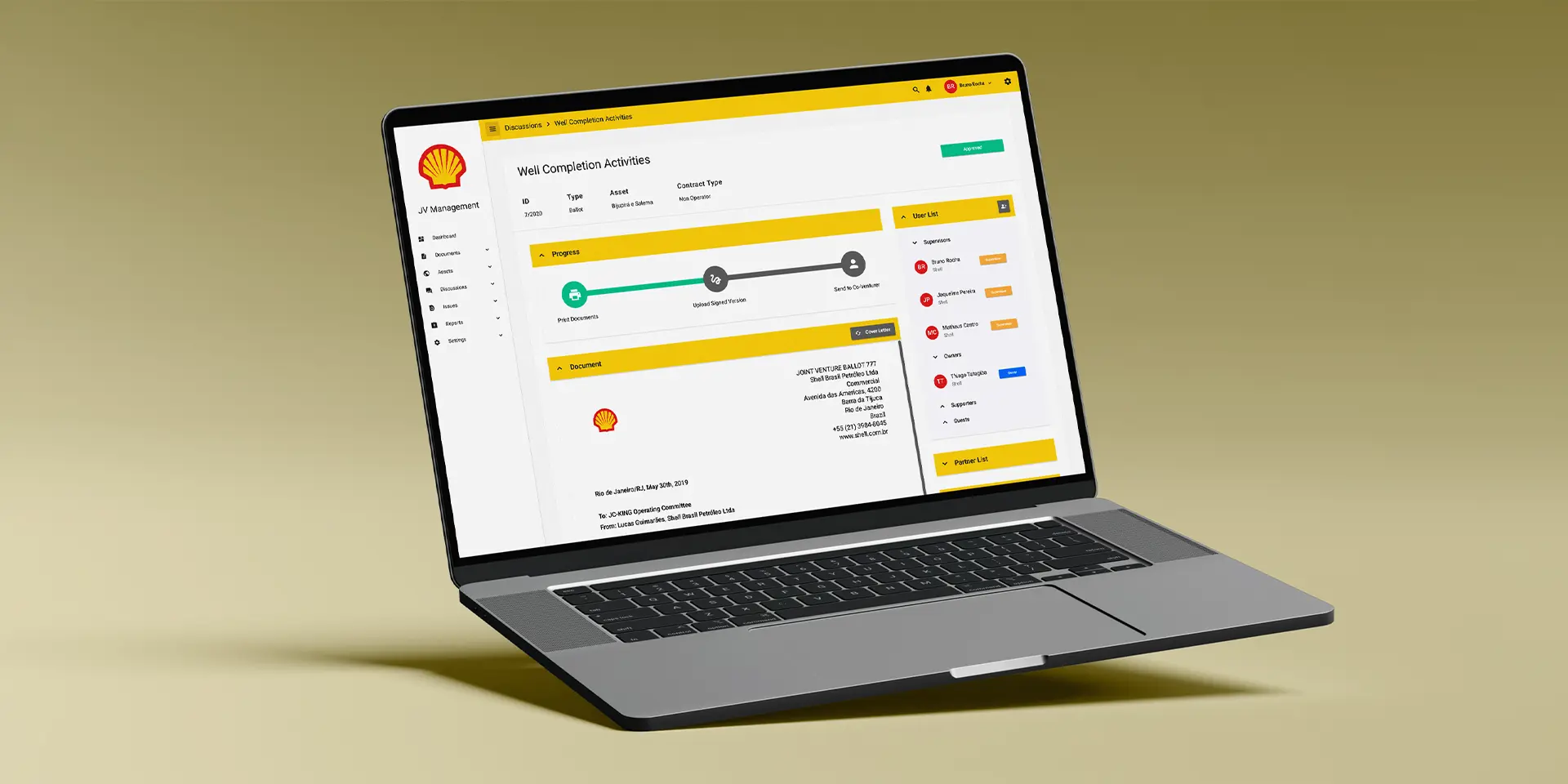
Shell needed a better way to manage joint venture operations across multiple teams, departments and business partners.
At the time, much of the work depended on manual processes, fragmented coordination and documentation flows that were slow, difficult to track and vulnerable to human error. As complexity increased, the existing model became harder to sustain and more expensive to operate.
The opportunity was to redesign this operational layer as a unified digital product that could support contract collaboration, improve visibility across workflows and reduce the friction created by disconnected manual routines.
The platform also needed to work in cloud environments while supporting offline access for users operating on offshore extraction platforms.
The result was a more structured and dependable system that simplified a high-stakes operational process, reduced execution time and created a stronger foundation for scale.
The existing joint venture process was functional, but inefficient.
Critical tasks were handled through manual inputs, repeated validations and fragmented handoffs between departments. Teams often relied on email chains, disconnected documents and individual follow-up to move work forward. This slowed execution, limited visibility and increased the chance of avoidable mistakes.
The main issues were clear:
• too many manual steps in core workflows
• low visibility into contract status and venture data
• inconsistent coordination across legal, administrative and logistics teams
• heavy reliance on follow-up and informal knowledge
• no seamless experience for users who needed offline access offshore
What made the challenge especially complex was the fact that this was not a single-team workflow. The system had to support multiple departments with different priorities, responsibilities and approval paths, while still feeling coherent and easy to use.
The design strategy focused on making the workflow more structured, more collaborative and easier to trust.
Three principles guided the solution.
Make complex work easier to move through
Manual routines were redesigned into clearer digital flows that reduced repetition, supported better sequencing and helped users complete tasks with less friction.
Support collaboration where work actually happens
Contract creation and review involved multiple teams and stakeholders, so the product needed to make collaboration feel built in rather than bolted on.
Improve visibility so decisions happen faster
The system was designed to surface relevant joint venture information more clearly, helping users understand status, context and next steps without relying on side conversations or manual checks.
This approach helped turn a fragmented process into a product that felt coordinated and operationally useful.
The work began with restructuring the joint venture workflow into a product model that better reflected how teams actually operated.
Early exploration focused on defining the right information architecture, clarifying task progression and simplifying the moments where users had to coordinate across teams. One of the most important areas was collaborative contract management, which required a careful balance between flexibility, traceability and clarity.
From there, flows and interfaces were designed to make complex operations easier to navigate while preserving the level of detail required in a high-accountability environment.
The product also had to support offline usage for offshore teams, which meant the experience had to remain reliable even in constrained environments. That requirement shaped several interaction and system decisions, especially around access, continuity and workflow resilience.
Throughout the process, design decisions were refined in close collaboration with developers and stakeholders to ensure the product would work not only in theory, but in the reality of Shell’s operational environment.
The final product introduced a centralized platform for managing joint venture workflows with greater speed, consistency and control.
It enabled users to:
• create and manage contracts in a more collaborative environment
• track venture information with clearer real-time visibility
• reduce dependency on manual handoffs and status checks
• move work across departments with better structure and accountability
• continue operating in both cloud and offline contexts when needed
The redesign made the workflow feel significantly more coordinated. Instead of navigating scattered information and repetitive validation steps, users could work within a clearer system that supported progress, reduced ambiguity and improved confidence in execution.
This was not just a digitization effort. It was a redesign of how the work moved.
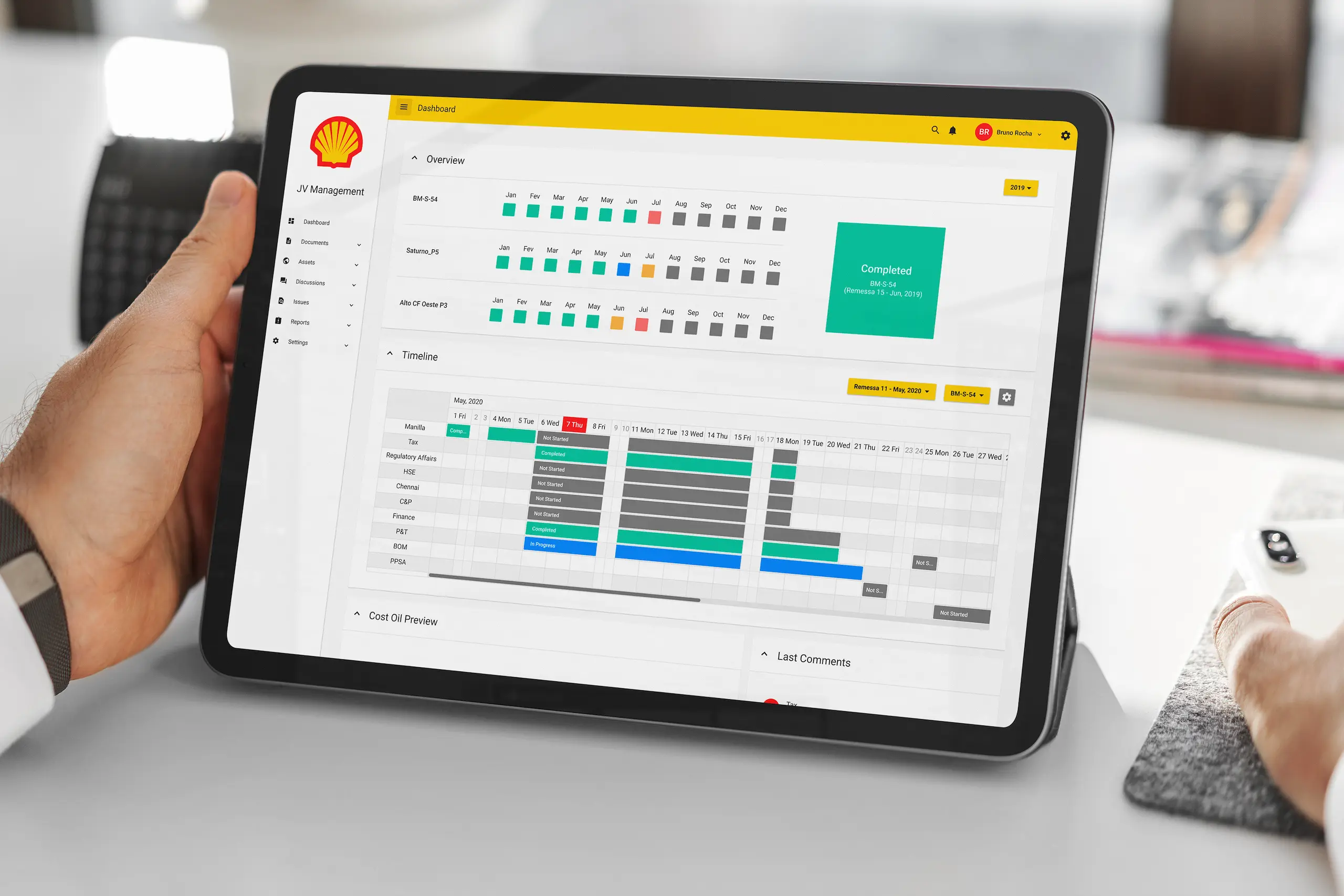
The new platform delivered measurable operational improvements across Shell’s joint venture management process.
By replacing fragmented manual routines with structured digital workflows, the system reduced average process time by 42% and lowered reported manual handling errors by 35%. Teams were able to move faster, spend less time on follow-up and work with greater confidence in the accuracy of shared information.
The product also improved coordination across departments by making contract progress and venture data easier to understand and act on. This reduced operational friction in one of the most complex parts of the business.
Its value became clear through rapid voluntary adoption across Shell subsidiaries in Latin America, which showed that the platform was not only usable, but genuinely helpful in diverse operational settings.
The new platform delivered measurable operational improvements across Shell’s joint venture management process.
By replacing fragmented manual routines with structured digital workflows, the system reduced average process time by 42% and lowered reported manual handling errors by 35%. Teams were able to move faster, spend less time on follow-up and work with greater confidence in the accuracy of shared information.
The product also improved coordination across departments by making contract progress and venture data easier to understand and act on. This reduced operational friction in one of the most complex parts of the business.
Its value became clear through rapid voluntary adoption across Shell subsidiaries in Latin America, which showed that the platform was not only usable, but genuinely helpful in diverse operational settings.